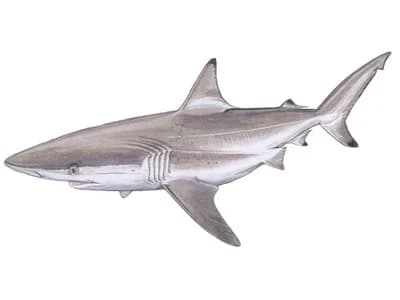
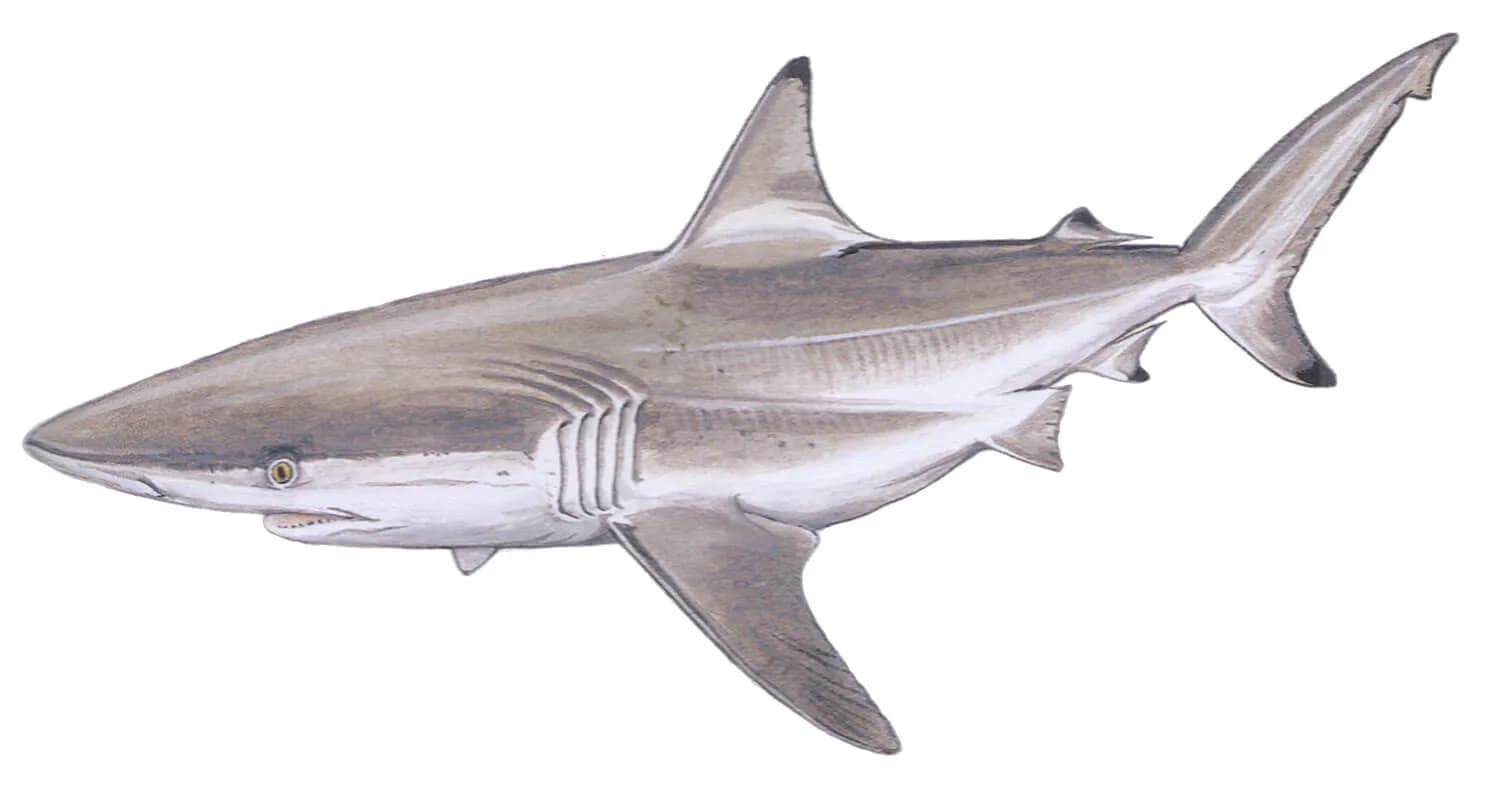
Similar to the blacktip shark but slenderer, with a proportionally smaller eye. Named for its habit of spinning out of the water in tight spirals when chasing baitfish schools. Common in warm coastal waters.
Habitat
Coastal-pelagic on continental and insular shelves, common in shallow coastal waters from the surface to the bottom.
Distribution
Tropical & subtropical seas worldwide
Warm temperate and tropical Atlantic, Mediterranean and Indo-Pacific.
Behavior
This is an active, schooling shark. It often makes feeding runs through schools of fish ending in a spinning leap out of the water.
Human Safety
Spinner sharks are sometimes attracted to divers who are spearfishing. Although a Spinner shark has never been implicated in a fatality, the species has bitten humans.
Biology
Diet
Primarily fish, but also feeds on stringrays and cephalopods.
Reproduction
Viviparous (livebearing) with embryos nourished by a yolk-sac placenta
Birth Size
75cm
Male Maturity
2.03m
Appearance
Dorsal
Gray to bronze above, white underside, with a faint white bank on its flank. The second dorsal, anal, and pectoral fins as well as the lower lobe of the caudal fin have black or dark gray tips in large juveniles and adults. The pelvic, first dorsal, and dorsal caudal lobe may also have black tips, but not always. The fins of young sharks are unmarked.
Dentition
Upper jaw
This species has a narrow jaw and small narrow-cusped teeth of a fish-eating shark.
Counts are based on the species field of the Global Shark Attack File. Identifications by witnesses are often uncertain; treat figures as recorded incidents, not authoritative totals.
Frequently Asked Questions
How many shark attacks have been recorded involving the spinner shark?▾
50 incidents in the Global Shark Attack File mention the spinner shark, of which 0 were fatal (0.0%). Note that witness species identifications are often uncertain, so this is the count of recorded incidents.
Where do most spinner shark incidents occur?▾
The countries with the most recorded spinner shark incidents are United States, South Africa, Tunisia.
Is the spinner shark dangerous to humans?▾
The spinner shark is considered relevant to human-shark incidents and has been recorded in the Global Shark Attack File. As with any large shark, encounters in the wild should be avoided.
Where does this species data come from?▾
Species profiles are compiled from peer-reviewed taxonomy and published references. Incident data is sourced from the Global Shark Attack File and joined to species records by name match.

 Shark Data Lab