
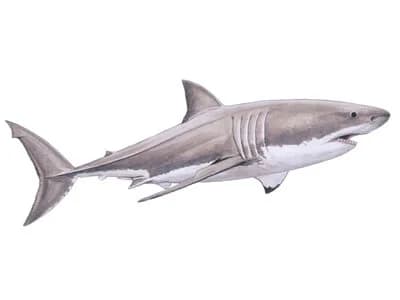
Carcharodon carcharias
Max Length
6.1m
Overview
The largest predatory fish on Earth. Responsible for the most recorded unprovoked attacks on humans globally. Endothermic. Bite-and-release behavior is the norm with humans — most victims are not consumed.
Habitat
This is a coastal and offshore shark of continental and insular shelves. The shark has been found off oceanic islands, and it also occurs close inshore. It penetrates shallow bays in coastal waters and may even venture into the surf. The shark is frequently found in the vicinity of pinniped colonies and has been caught at a depth of 4,199 ft [1280 m].
Distribution
Temperate, subtropical and tropical waters worldwide. In the western Atlantic: Newfoundland to Argentina, including the Bahamas. Eastern Atlantic: France to the Cape of Good Hope, and the Mediterranean Sea. Eastern Pacific: Gulf of Alaska to Chile. Central Pacific: Easter Island, Hawaiian Islands and Marshall Islands. Western Pacific: Siberia to Tasmania. Red Sea and Indian Ocean including South Africa and Mozambique, Madagascar, Mauritius and Seychelles, and Western Australia.
Behavior
This is the super-predator; it is without question the most formidable of all sharks. The white shark swims stiffly, and is capable of great speed. A shark, implanted with a sonic tag, had an average cruising speed of 3.2 kph. The shark sometimes raises its head above the water (?spy hops?), a behavior frequently observed in the vicinity of seal colonies and in baited situations.White sharks, especially adults, appear to be more cautious than other sharks, and are likely to assess a situation before deciding how to react. This may be one reason fewer white sharks are caught by fishermen than other species of sharks.
Human Safety
The white shark is intelligent, curious and learns by experience. However the shark does not have hands and it often uses its teeth to inspect an unfamiliar object.
Biology
Appearance
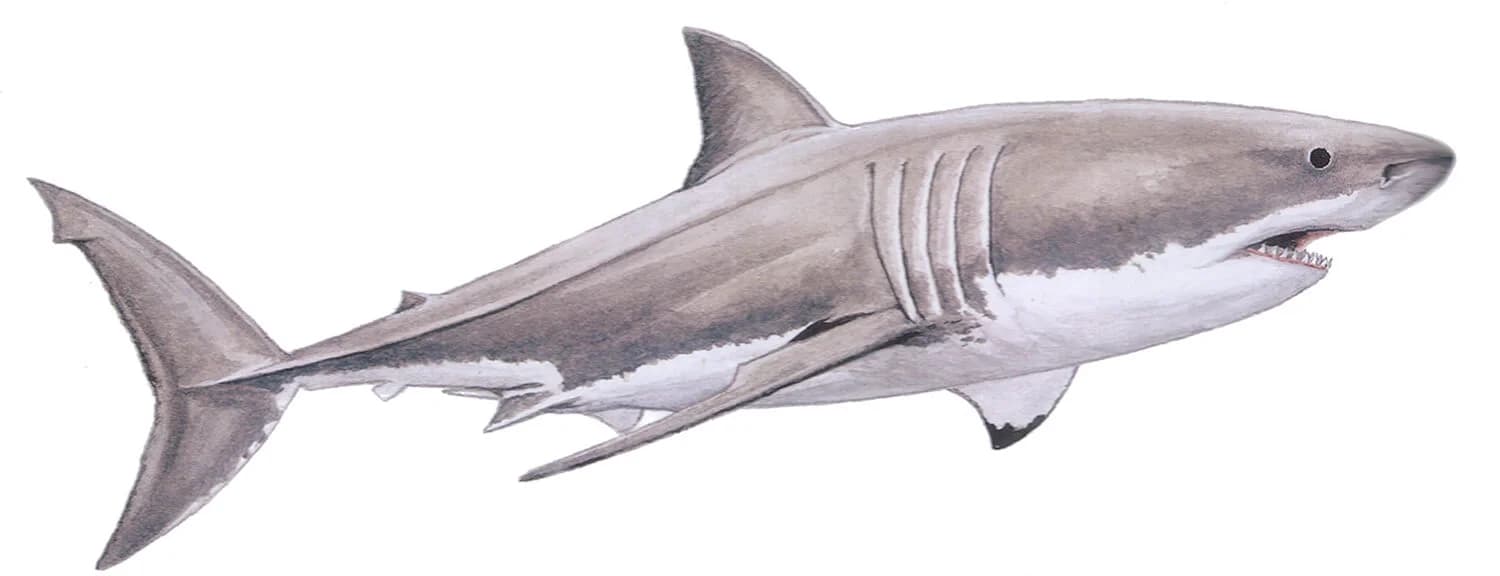
Dentition
Conservation
This species is protected in South African territorial waters. It is also a protected species along the eastern coast of the United States, Malta and Australia. In 2004, the white shark was listed on Appendix II of CITES, and it is listed on Appendix I and II of CMS (Bonn Convention).
Recorded
727
Fatal
173
Fatality rate
23.8%
Years
1554–2026
Top countries
Counts are based on the species field of the Global Shark Attack File. Identifications by witnesses are often uncertain; treat figures as recorded incidents, not authoritative totals.
 Shark Data Lab