
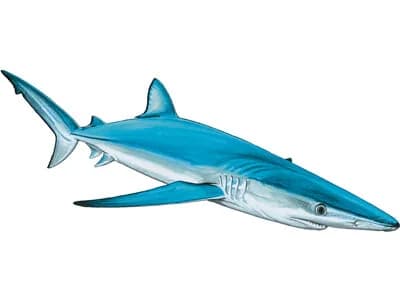
Prionace glauca
Max Length
3.8m
Litter Size
4-135 pups
Overview
The most wide-ranging shark on Earth, found from polar to tropical seas. Built for sustained open-ocean cruising. The most heavily fished shark globally — estimated tens of millions killed annually as longline bycatch.
Habitat
Oceanic and pelagic, usually off the edge of the continental shelf from 0 to 1148.3 ft [0 to 350 m] (deeper in warmer waters). Migrations often follow major trans-oceanic currents. They occasionally venture inshore at night, particularly around oceanic islands or where the continental shelf is narrow. Their nursery areas are offshore.
Distribution
The shark is located world-wide in temperate and tropical oceanic waters (temperature 44.6 to 77ºF [7 to 25ºC], preferably 53.6 to 68ºF [12 to 20ºC], latitude 60ºN to 50ºS. Possibly the most wide-ranging of sharks because they live in such a broad range of areas.
Behavior
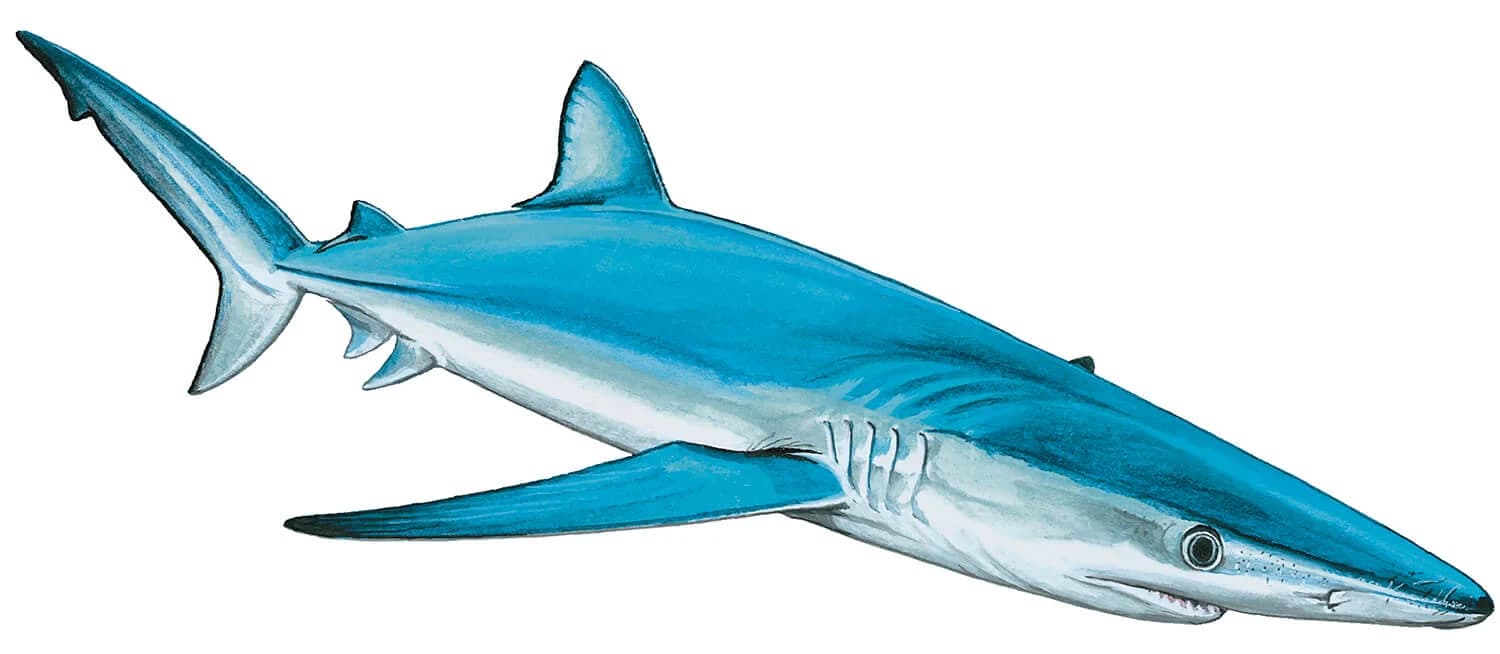
Blue sharks cruise slowly at the surface with the tips of their dorsal and tail fins out of the water, and long pectoral fins extended. These sharks are most active in the early evening and at night when they may move inshore. They form large aggregations (where still sufficiently abundant) to feed on shoals of prey or carrion. They are highly migratory with complex movements related to prey availability and reproductive cycles. Blue sharks segregate by age, sex, and reproductive phase: juveniles, sub-adults, mature sharks, and pregnant females are usually found in separate areas, with adult males and females meeting only briefly to mate. The sharks move seasonally to higher latitudes where prey is more abundant in productive oceanic convergence or boundary zones. They have frequent vertical excursions made into deep water or to the thermocline, returning regularly to the surface (possibly to prevent body cooling). Tagging studies have demonstrated that Atlantic Blue Sharks undertake numerous trans-Atlantic migrations, swimming slowly with the major current systems. Pacific blue sharks may migrate up to 5716.6 miles [9200 km].
Biology
Appearance
Dentition
Recorded
61
Fatal
11
Fatality rate
18.0%
Years
1876–2026
Top countries
Counts are based on the species field of the Global Shark Attack File. Identifications by witnesses are often uncertain; treat figures as recorded incidents, not authoritative totals.
 Shark Data Lab