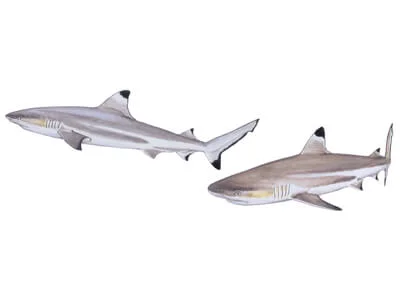
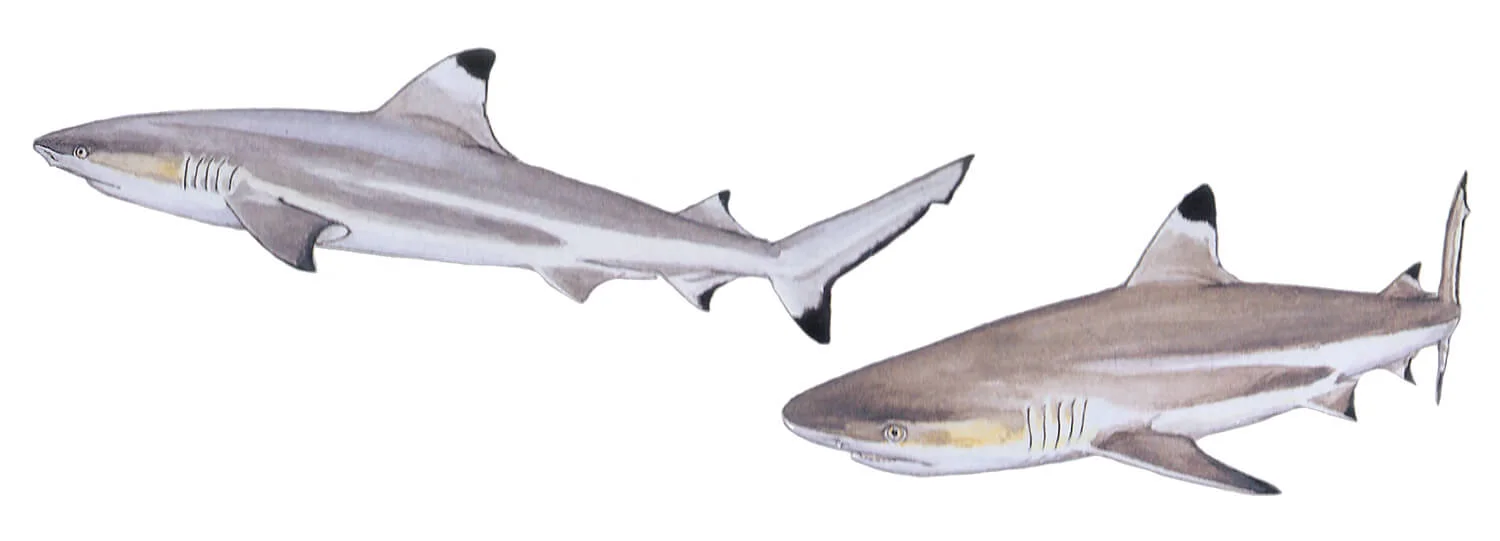
Facilement identifiable par les pointes noires distinctives sur toutes les nageoires. Abondant sur les platiers de récifs de l'Indo-Pacifique et de la mer Rouge, souvent dans une eau de moins de 30 cm de profondeur. Responsable d'incidents mineurs de pataugeage
Habitat
C'est le requin le plus couramment rencontré dans les eaux tropicales de l'Indo-Pacifique
Distribution
Indo-Pacific Ocean
Pacifique occidental et océan Indien
Behavior
À marée montante, des nuées de requins-pointes noires se déplacent sur les platiers de récifs peu profonds. On les voit souvent nager dans une eau peu profonde avec les pointes de leurs nageoires dorsales qui émergent de la surface
Human Safety
Le requin-pointe noire des récifs est souvent très curieux lorsque les plongeurs entrent dans l'eau, mais il peut généralement être repoussé. Il devient fréquemment agressif autour de poissons harponnés, et cela peut être exacerbé par la présence de requins concurrents. Dans ces scénarios, les requins-pointes noires des récifs se précipitent pour attraper les poissons blessés ou les appâts
Biology
Diet
Petits poissons et invertébrés : mulets, mérous, carangues, mojarres, poissons à mâchoires glissantes, labres, poissons chirurgiens, seiches, calamars, poulpes, crevettes
Reproduction
Vivipare, avec un placenta vitellin
Male Maturity
1.8m
Appearance
Dorsal
Light brown or bronze above, white below. First dorsal fin and ventral caudal lobe have a conspicuous black blotch, brilliantly highlighted with white. Other fins have black fin tips. Conspicuous white band on flank.
Dentition
Upper jaw
Teeth of the upper jaw are narrow and erect with coarse serrations and cusplets,
Lower jaw
jaw teeth are erect to oblique with narrow serrated cusps.
Conservation
Danger to humans – This species is responsible for non-fatal incidents involving spearfishermen, surfers, swimmers and waders. Most bites have been on limbs of people wading in shallow water on coral reefs.
Sources:sharksorg
Recorded incidents involving the blacktip reef shark
Counts are based on the species field of the Global Shark Attack File. Identifications by witnesses are often uncertain; treat figures as recorded incidents, not authoritative totals.
Frequently Asked Questions
How many shark attacks have been recorded involving the blacktip reef shark?▾
10 incidents in the Global Shark Attack File mention the blacktip reef shark, of which 0 were fatal (0.0%). Note that witness species identifications are often uncertain, so this is the count of recorded incidents.
Where do most blacktip reef shark incidents occur?▾
The countries with the most recorded blacktip reef shark incidents are United States, French Polynesia, Trinidad & Tobago.
Is the blacktip reef shark dangerous to humans?▾
The blacktip reef shark is considered relevant to human-shark incidents and has been recorded in the Global Shark Attack File. As with any large shark, encounters in the wild should be avoided.
Where does this species data come from?▾
Species profiles are compiled from peer-reviewed taxonomy and published references. Incident data is sourced from the Global Shark Attack File and joined to species records by name match.

 Shark Data Lab