Shark Data Lab logoShark Data Lab
Blacktip Reef Shark
CarcharhiniformesAttack Relevant

Blacktip Reef Shark

Carcharhinus melanopterus

Back to species

Max Length

1.8m

Litter Size

2 to 4 pups

Overview

Easily identified by the distinctive black tips on all fins. Abundant on Indo-Pacific and Red Sea reef flats, often in water less than 30 cm deep. Responsible for minor wading incidents.

Habitat

This is the most commonly encountered shark in the tropical Indo-Pacific

Distribution

Indo-Pacific Ocean

Western Pacific and Indian Ocean.

Behavior

On flood tide swarms of blacktip reef sharks move over shallow reef flats. They are often seen swimming in calf-deep water with the tips of their dorsal fins breaking the surface.

Human Safety

The blacktip reef shark is often quite inquisitive when divers enter the water, but it can usually be driven off. It frequently becomes aggressive around speared fish, and this may be exacerbated by the presence of competing sharks. In these scenarios Blacktip reef sharks will rush in to take wounded fish or baits.

Biology

Diet
Small fish and invertebrates: mullets, groupers, jacks, mojarras, slipjaws, wrasses, surgeonfish, cuttlefish, squid, octopus, shrimp.
Reproduction
Viviparous, with a yolk sac placenta
Male Maturity
1.8m

Appearance

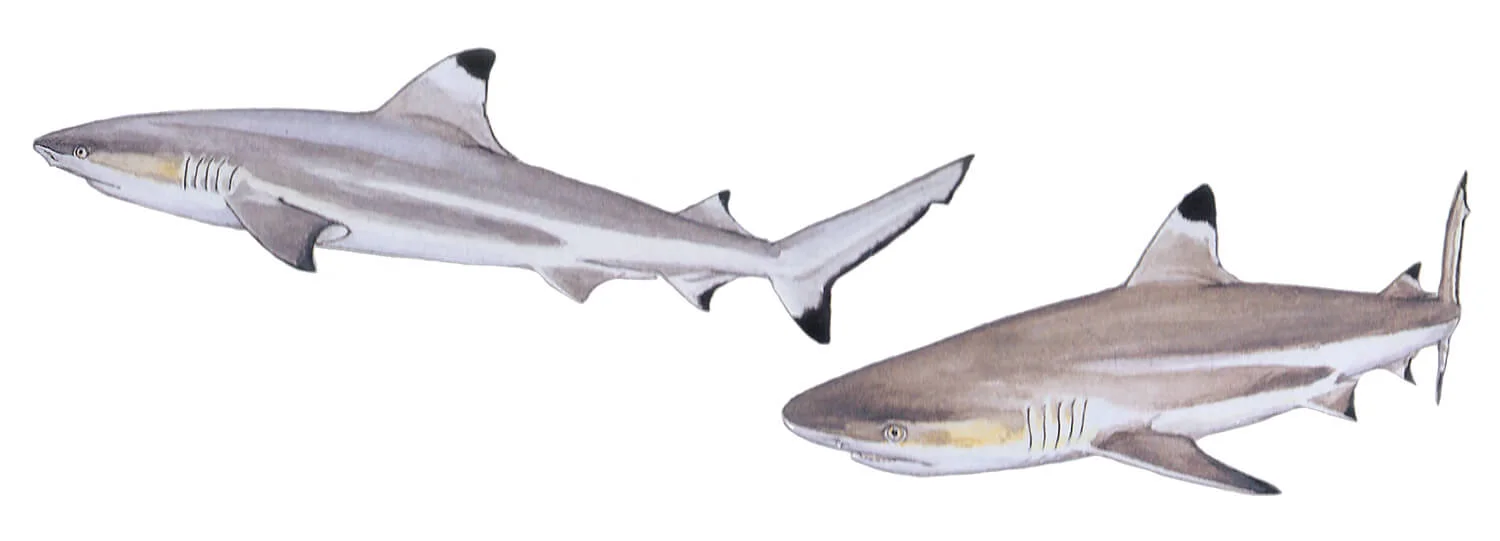
Blacktip Reef Shark illustration
Dorsal
Light brown or bronze above, white below. First dorsal fin and ventral caudal lobe have a conspicuous black blotch, brilliantly highlighted with white. Other fins have black fin tips. Conspicuous white band on flank.

Dentition

Upper jaw
Teeth of the upper jaw are narrow and erect with coarse serrations and cusplets,
Lower jaw
jaw teeth are erect to oblique with narrow serrated cusps.

Conservation

Danger to humans – This species is responsible for non-fatal incidents involving spearfishermen, surfers, swimmers and waders. Most bites have been on limbs of people wading in shallow water on coral reefs.

Sources:sharksorg

Recorded incidents involving the blacktip reef shark

Recorded

10

Fatal

0

Fatality rate

0.0%

Years

1954–2024

Counts are based on the species field of the Global Shark Attack File. Identifications by witnesses are often uncertain; treat figures as recorded incidents, not authoritative totals.

Frequently Asked Questions

How many shark attacks have been recorded involving the blacktip reef shark?
10 incidents in the Global Shark Attack File mention the blacktip reef shark, of which 0 were fatal (0.0%). Note that witness species identifications are often uncertain, so this is the count of recorded incidents.
Where do most blacktip reef shark incidents occur?
The countries with the most recorded blacktip reef shark incidents are United States, French Polynesia, Trinidad & Tobago.
Is the blacktip reef shark dangerous to humans?
The blacktip reef shark is considered relevant to human-shark incidents and has been recorded in the Global Shark Attack File. As with any large shark, encounters in the wild should be avoided.
Where does this species data come from?
Species profiles are compiled from peer-reviewed taxonomy and published references. Incident data is sourced from the Global Shark Attack File and joined to species records by name match.