Un requin primitif à sept branchies habitant les baies côtières froides des mers tempérées. Prédateur puissant en meute de mammifères marins ; a été documenté lors d'un comportement de chasse coopérative. Responsable d'incidents dans la baie de San Francisco.
Habitat
Marin, benthique, néritique sur les plateaux continentaux de la surface à 150 ft [46 m]. C'est une espèce côtière couramment trouvée dans les baies peu profondes.
Distribution
Southwest Pacific & Australia
Mers tempérées.
Behavior
C'est un requin actif et puissant. Il se déplace vers la côte à marée haute et se retire au large à marée basse. La plupart des spécimens sont observés en train de croiser près du fond, mais ils peuvent aussi être trouvés à la surface. Les juvéniles se trouvent fréquemment dans les eaux peu profondes près de la côte.
Human Safety
Danger pour l'homme – inconnu. Le requin est agressif quand il est provoqué. Dans les eaux australiennes et néo-zélandaises, ce requin est considéré comme dangereux.
Biology
Diet
Poissons osseux, raies et autres requins
Reproduction
Ovovivipare
Birth Size
53cm
Male Maturity
1.8m
Appearance
Dorsal
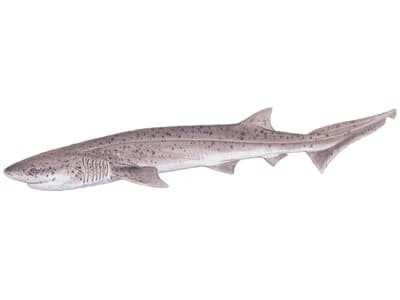
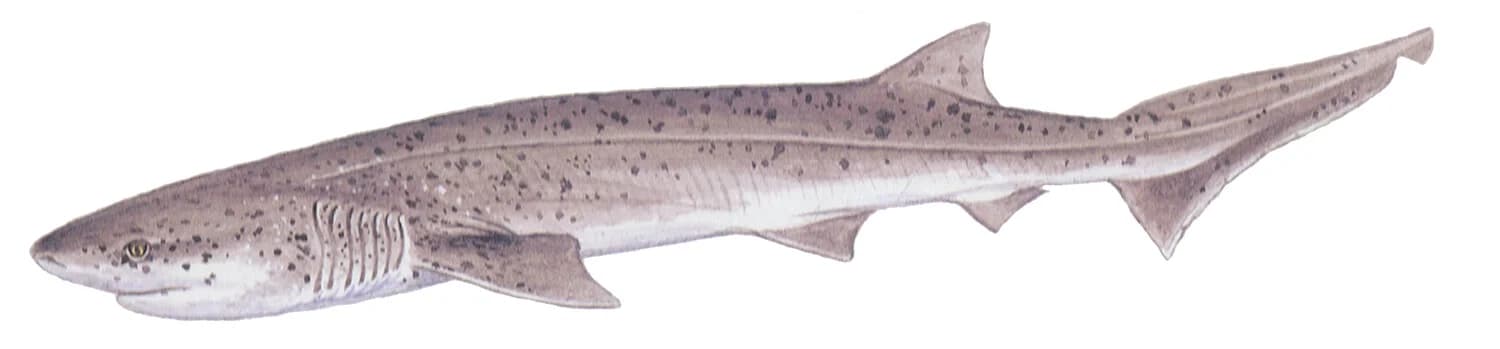
Pale gray above; white below. Small black spots on body.
Dentition
Upper jaw
Teeth of the upper jaw are blunt and pointed; teeth of the
Lower jaw
jaw are large broad and saw-like with 5 or 6 distal cusplets.
Sources:sharksorg
Recorded incidents involving the broadnose sevengill shark
Counts are based on the species field of the Global Shark Attack File. Identifications by witnesses are often uncertain; treat figures as recorded incidents, not authoritative totals.
Frequently Asked Questions
How many shark attacks have been recorded involving the broadnose sevengill shark?▾
18 incidents in the Global Shark Attack File mention the broadnose sevengill shark, of which 0 were fatal (0.0%). Note that witness species identifications are often uncertain, so this is the count of recorded incidents.
Where do most broadnose sevengill shark incidents occur?▾
The countries with the most recorded broadnose sevengill shark incidents are New Zealand, United States, Australia.
Is the broadnose sevengill shark dangerous to humans?▾
The broadnose sevengill shark is considered relevant to human-shark incidents and has been recorded in the Global Shark Attack File. As with any large shark, encounters in the wild should be avoided.
Where does this species data come from?▾
Species profiles are compiled from peer-reviewed taxonomy and published references. Incident data is sourced from the Global Shark Attack File and joined to species records by name match.

 Shark Data Lab