
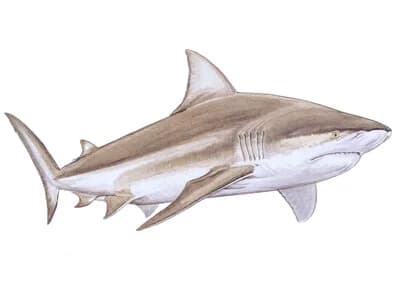
Carcharhinus leucas
Max Length
3.4m
Litter Size
1 to 13 pups
Overview
One of the most dangerous sharks due to its aggression, territorial behavior, and unique ability to survive in both salt and freshwater. Responsible for many attacks in murky coastal and river waters worldwide.
Habitat
Usually found close inshore in water less than 100 ft [30m] deep.
Distribution
Tropical and subtropical shallow coastal waters worldwide. This species has the ability to penetrate fresh water; it has been caught 2,294 miles [3,691 km] up the Amazon River in Peru, 340 miles [547 km] up the Zambesi River, and Lake Nicaragua has a landlocked population.
Behavior
General – divers report that the sharks are rarely seen at the surface; most are observed cruising over the top of the reef, and are frequently hosts to remoras.
Human Safety
This is a large, aggressive shark with massive jaws and it moves like a seasoned warrior. The GSAF has several cases in which the rapid ascent of a diver may have ‘released’ an aggressive response (similar to when an intruder flees from a guard dog). In each case, after a single bite on the diver’s leg (no tissue was removed by the shark), the shark sped back to the reef. More often, when this shark bites, it resembles a pit bull; it makes multiple bites accompanied by head-shaking to remove tissue, and inflicts injuries that are far more difficult to repair than those caused by a white shark. Perhaps because the shark scavenges on carrion and may make forays into polluted areas, wounds caused by this species have a higher-than-usual rate of infection.
Biology
Appearance
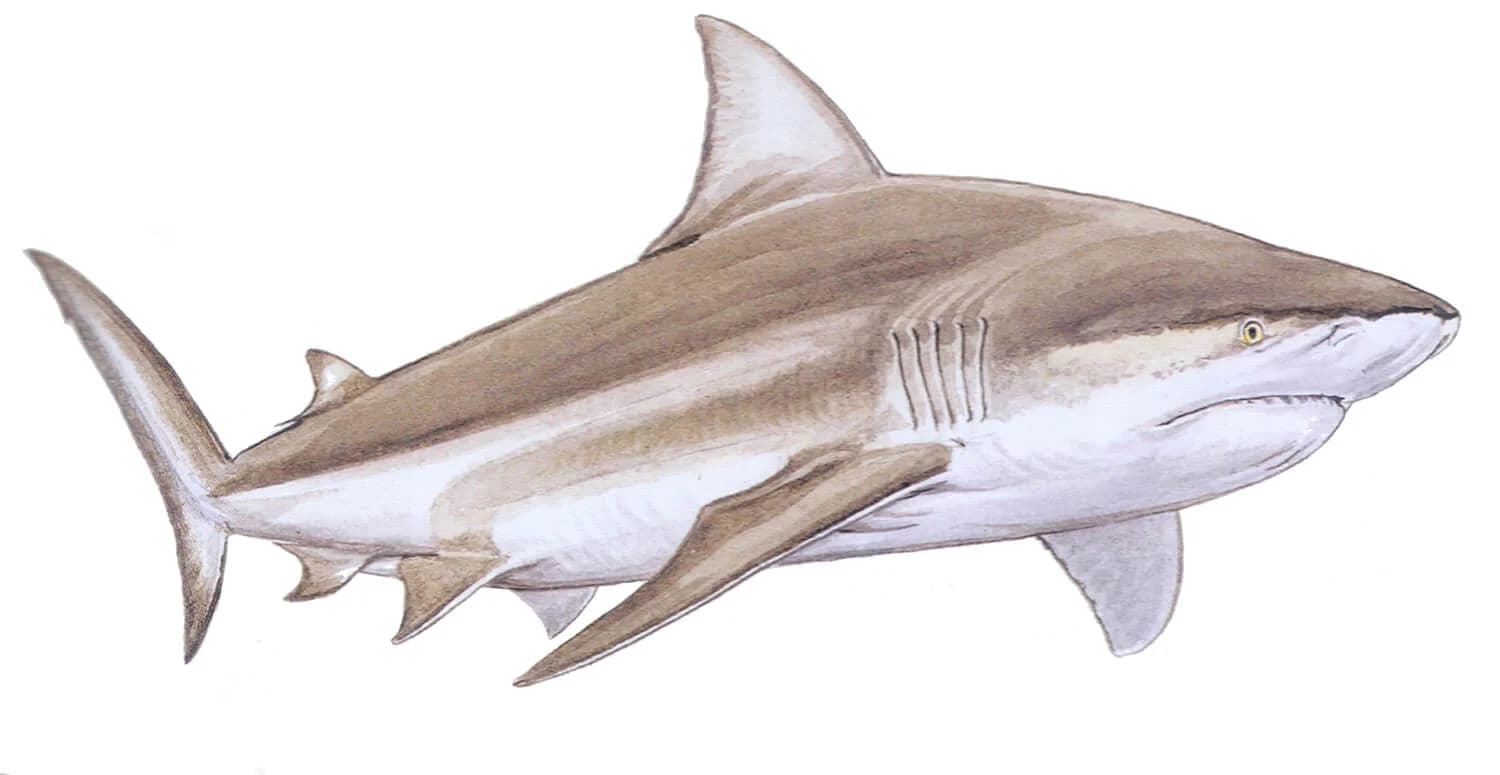
Dentition
Conservation
Danger to humans – due to its size, dentition and aggressiveness, it is regarded as one of the most dangerous tropical sharks.
Recorded
273
Fatal
56
Fatality rate
20.5%
Years
1880–2026
Top countries
Counts are based on the species field of the Global Shark Attack File. Identifications by witnesses are often uncertain; treat figures as recorded incidents, not authoritative totals.
 Shark Data Lab