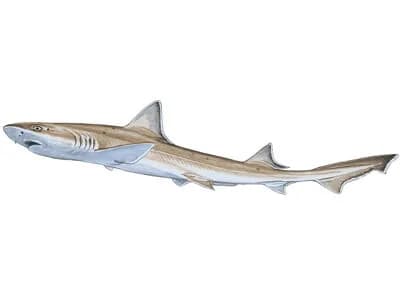
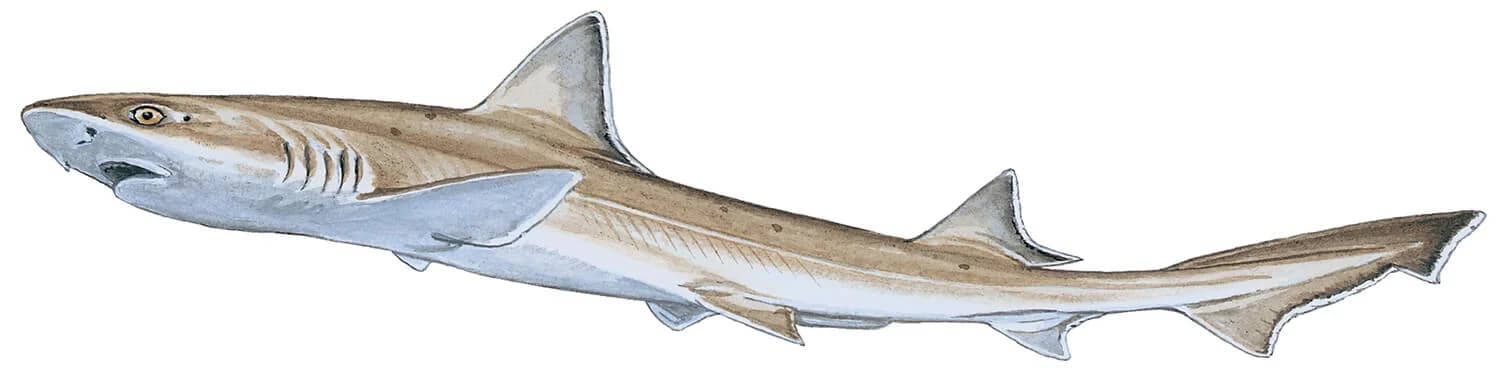
A small, harmless houndshark common in the eastern Atlantic and Mediterranean. Feeds on crustaceans and small fish over sandy and muddy inshore habitats. Often taken as bycatch.
Habitat
These sharks reside on continental shelves and upper slopes, usually between 16.4 to164 ft [5 to 50 m] deep, but are often found in intertidal zones to at least 1148.3 ft [350 m].
Distribution
Northeast Atlantic & Mediterranean
They prefer the temperate east Atlantic from the UK to the Mediterranean, Morocco, Canaries, and possibly the Azores, Madeira. They are also found in Angola to South Africa, including the Indian Ocean coast.
Behavior
They prefer swimming near the bottom, but sometimes can be found in mid-water.
Biology
Diet
Primarily crustaceans, but also cephalopods and bony fishes.
Reproduction
Viviparous, yolk-sac placenta, with 4-15 pups per litter after a 10-11 month gestation
Gestation
10-11
Appearance
Dorsal
The shark is usually grey to grey-brown. Occasionally has dark spots.
Counts are based on the species field of the Global Shark Attack File. Identifications by witnesses are often uncertain; treat figures as recorded incidents, not authoritative totals.
Frequently Asked Questions
How many shark attacks have been recorded involving the smoothhound?▾
1 incidents in the Global Shark Attack File mention the smoothhound, of which 0 were fatal (0.0%). Note that witness species identifications are often uncertain, so this is the count of recorded incidents.
Where do most smoothhound incidents occur?▾
The countries with the most recorded smoothhound incidents are United Kingdom.
Is the smoothhound dangerous to humans?▾
The smoothhound is not considered dangerous to humans under normal conditions. There are few or no recorded incidents involving this species.
Where does this species data come from?▾
Species profiles are compiled from peer-reviewed taxonomy and published references. Incident data is sourced from the Global Shark Attack File and joined to species records by name match.

 Shark Data Lab